
Building on my earlier RAG built from my blog data, I tried something new this time: building a retrieval evaluation test set and comparing embedding model performance. The experiment: index the same blog data separately with OpenAI text-embedding-3-small and bge-m3, then search with the same question set and compare the rankings.
Table of contents
Open Table of contents
- Why rank comparison (recall@k)
- In RAG, recall matters more than precision
- Preparing the test set — similar to labeling
- Execution — 441 chunks, 20 questions
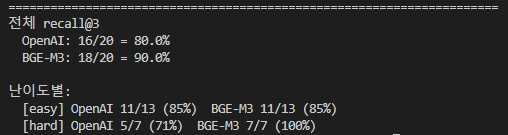
- Results — bge-m3 90%, OpenAI 80%
- Why the gap on Hard — the ability to connect by meaning
- Why the misses on Easy — typos were the cause
- Retrospective
- Things to study further
Why rank comparison (recall@k)
recall@k — a metric that checks whether the correct answer was found within the top k results.
- If the correct answer landed in the top 3 for 17 out of 20 questions → recall@3 = 85%
Comparing absolute values is difficult because each model has a different baseline for similarity scores (a problem I ran into in Eval #2 — bge-m3’s zero point is inherently higher). recall@k only looks at whether the correct answer made it into the top ranks, which makes a fair comparison possible.
In RAG, recall matters more than precision
Why recall matters far more than precision in RAG retrieval:
- If recall is low, you miss the correct chunk → the LLM answers without grounding (or responds with “not found in the material”)
- Ideally top-3 would contain only the correct answer, but even if it’s mixed with the correct answer plus 2 irrelevant chunks, the LLM can still see the correct chunk and answer properly
- In other words, the goal isn’t to have only correct answers in the top ranks — it’s to include the correct answer
Preparing the test set — similar to labeling
Building a test set = organizing questions plus the conditions that a correct answer should satisfy. Grading criteria:
- The expressions that should appear in the answer to the question
- The tools that should be used
- The sources that should be used
Defining these in advance is essentially a labeling task.
Source-based vs chunk-based grading
| Method | Grading unit | Characteristics |
|---|---|---|
| Source-based | Which article it’s in | Flexibly accepts correct answers split across multiple chunks |
| Chunk-based | Which specific chunk | More precise, but harder to manage when there are multiple correct chunks |
This time I went with source-based grading — scored by the correct source document (slug).
Execution — 441 chunks, 20 questions
Indexing:
- OpenAI
text-embedding-3-small - bge-m3 (Ollama)
Since this is based on my own blog posts, I built the test set myself. Minimum fields:
{
  "question": "Prompt Caching 은 어떻게 동작?",
  "answer_source": "claude-api-prompt-caching",
  "level": "easy"  # AI 툴로 분류 — 내가 판단하기 애매
}
I used an AI tool for the level field since it was hard for me to judge myself. The result was 13 easy questions / 7 hard questions.
Results — bge-m3 90%, OpenAI 80%
| Easy (13 questions) | Hard (7 questions) | Overall (20 questions) | |
|---|---|---|---|
| OpenAI | 11/13 (85%) | 5/7 (71%) | 16/20 (80%) |
| bge-m3 | 11/13 (85%) | 7/7 (100%) | 18/20 (90%) |
Tied on Easy, bge-m3 dominates on Hard.
Why the gap on Hard — the ability to connect by meaning
The characteristic of the Hard questions: the wording doesn’t overlap with the source text. For example:
- Question: “How should I set the retry interval when requests keep failing?”
- Source text: the exponential backoff section of Claude API Error Handling and Retry
The word exponential backoff doesn’t appear in the question. Yet bge-m3 connected the meaning of “retry with progressively increasing intervals” to exponential backoff in the source text. OpenAI couldn’t catch this.
Why the misses on Easy — typos were the cause
Even in the tied Easy category, both models missed the same 2 questions. Digging into the cause:
- A
-typo’d as_(e.g., searchingprompt-cachingasprompt_caching) claudetypo’d ascladue
Since the search used wording that didn’t exist in the documents, it makes sense that neither model could find it — in reality, the grading criteria itself was flawed.
If a supposedly easy question is missed for no clear reason, you should also consider whether the test set itself is at fault.
This time, both models missed the same 2 easy cases for this reason, so it turned into “test set typo → both models unfairly penalized.” If you correct the typos and re-measure, both models would hit 100% on easy, and the overall scores would become OpenAI 90% / bge-m3 100%.
Retrospective
Three things I took away from today:
- recall@k is a fair comparison tool across models — it judges by whether the answer entered the top ranks, not by absolute similarity values. This sidesteps bge-m3’s baseline-offset problem.
- In RAG, recall > precision — missing the correct answer is far worse than having irrelevant chunks mixed in.
- The quality of the test set itself is also something to verify — if both models miss the same thing, you should first suspect the grading criteria.
This experiment also ended up providing after-the-fact justification for the decision to adopt bge-m3 in FEMS #2. Back then I adopted it “because it’s specialized for Korean” — this time, I confirmed it with actual recall numbers.
Things to study further
1. Chunk-based grading
- Today’s evaluation was source (document) based. Moving to chunk-based grading would increase precision
- How to manage cases where there are multiple correct chunks (labeling chunk IDs in a golden set)
- The problem that labels become invalid when chunk size changes
2. Hybrid Search (from a typo-prevention perspective)
- The typo cases I found today couldn’t be caught by pure vector search
- A BM25 + vector combination could catch these via string similarity
- Combining the two results with Reciprocal Rank Fusion
3. Reranking
- Retrieve a wider top-K (e.g., K=20), then rerank with a cross-encoder
- An approach that maintains recall while improving precision in the top ranks
- Test whether today’s results improve using the
bge-rerankerseries
4. Expanding the embedding model catalog
- KoSimCSE / KoSBERT — standard Korean sentence embeddings
- multilingual-e5-large — multilingual
- Voyage AI multilingual — commercial
- Rank 5 models against the same test set
5. Separately evaluating RAG response quality (retrieval → generation)
- Today I only looked at retrieval (Hit Rate / Recall)
- Next up: answer quality — Faithfulness (whether it hallucinates), Answer Relevance (whether it addresses the question)
- Automating this with the RAGAS framework
6. Evaluating agent systems
- Tool selection accuracy (did the agent pick the right tool among several)
- Multi-step success rate (calling multiple tools in the correct sequence)
- Verifying that HITL safeguards actually work in practice