
Continuing from Java #2 Collections · Stream part, wrapping up the Java syntax sweep in this post. Today’s goal is to roughly finish sweeping through Java syntax — exception handling · concurrency · record · Modern Java · Gradle.
Table of contents
Open Table of contents
- 1. Exception Handling — A Safeguard So “The Server Doesn’t Die”
- 2. Custom Exceptions — Why Use Exceptions Instead of print
- 3. Concurrency — 3 Seconds Sequential → 1 Second Parallel
- 4. record — An Object That Carries Data
- 5. Modern Java — var · switch Arrow · Text Blocks
- 6. Gradle — Why Is It Needed
- Retrospective
- Further Study
1. Exception Handling — A Safeguard So “The Server Doesn’t Die”
Code: ExceptionDemo.java
I used to think exception handling was mostly for debugging convenience. What clicked this time was this:
If an exception isn’t caught in production, the backend server itself can die. Exception handling is the safeguard that keeps the service alive.
Running locally, it’s just “check the error log → fix it.” But in a real service, if a single request dies from an exception, not just the user who sent that request, but the thread itself can terminate. try / catch is the wall in between.
2. Custom Exceptions — Why Use Exceptions Instead of print
Code: CustomExceptionDemo.java
Custom exception = turning a specific exceptional situation into a reusable class. You throw it like throw new InvalidAgeException(...), and catch it above with catch (InvalidAgeException e).
Why throw an exception instead of just doing System.out.println("Error!") — here’s the intuition I got this time:
printdoesn’t convey the fact that “it failed” to the caller. The function just passes through quietly, and the caller thinks it succeeded.throwis forcibly propagated up the call stack. If it’s not handled, the thread dies (unchecked) or the code doesn’t compile (checked). It’s a contract that makes it impossible to ignore the fact that something failed.
Conceptually this is the same as Python’s raise / try / except, but Java has a separate category called checked exceptions, which requires you to declare in the method signature that “this method can throw this exception.” This is a level of enforcement that doesn’t exist in Python/JS.
3. Concurrency — 3 Seconds Sequential → 1 Second Parallel
Code: ThreadDemo.java
Parallelized a task that was previously processed sequentially, using ExecutorService + newFixedThreadPool. With 3 tasks that each take 1 second:
- Sequential: 1 second × 3 = 3 seconds
- Concurrent (thread pool of 3): throw one to each of 3 threads → done in 1 second
Actual run result:
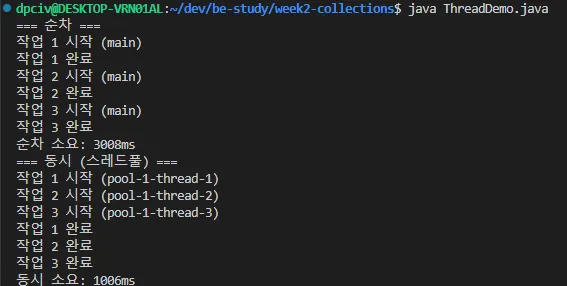
3008ms → 1006ms — almost matches the theoretical value. The threads show up in the log as pool-1-thread-1, pool-1-thread-2, pool-1-thread-3, so parallel execution is visible.
This is the principle behind how backend servers handle multiple requests concurrently. Frameworks like Spring Boot also run this kind of thread pool internally.
4. record — An Object That Carries Data
Code: RecordDemo.java
record = a data container you use instead of class. Its purpose is to carry data only, with no behavior.
record Person(String name, int age) {}With just this one line, Java generates fields · constructor · accessors · toString · equals · hashCode all for you. Making the same thing with a class would take dozens of lines of boilerplate.
Back when I was looking at the source code for a rain gauge data logger, there was a file called RainDataDTO — a class packed with a few fields and nothing but getters/setters. I got the sense that this kind of “a set of data” type is exactly what record replaces.
5. Modern Java — var · switch Arrow · Text Blocks
Code: ModernDemo.java
Three modern Java features — things that feel familiar if you’re coming from Python:
var— type inference. Likevar name = "hyoin";, the type is inferred from the right-hand sideswitcharrow — thecase ... ->syntax I already covered in #1- Text blocks — multi-line strings with
"""..."""(similar to Python triple-quoted strings)
There’s a perception that Java = lots of old-style boilerplate, but using these recent syntax features makes it as concise as Python.
6. Gradle — Why Is It Needed
Up to this point, I ran the example files one by one with java ExceptionDemo.java. But once you have dozens or hundreds of files — compiling them one by one becomes impossible. And to use external libraries (e.g., Jackson, Guava, Spring Boot), manually downloading them and adding them to the classpath isn’t realistically feasible.
What Gradle does:
- Dependency management — write a library in
dependenciesand it gets fetched automatically - Compile & build — the whole project at once
- Packaging — bundles into a
.jarthat can be deployed to a server
Spring Boot projects are Gradle-based by default too, so it’s a tool you have to meet eventually anyway.
Gradle Project Structure
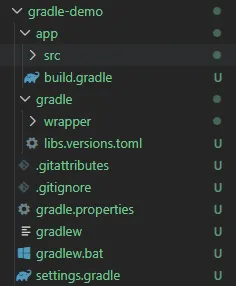
build.gradle— the core config file. Libraries are declared independenciesgradlew/gradlew.bat— per-project Gradle execution wrapper (eliminates worries about Gradle version mismatches between teammates)settings.gradle— project name, submodule configuration
Commands
gradle run       # run
gradle build     # build → generates app/build/libs/app.jar
Upload app.jar to a server and run it with java -jar app.jar, and deployment is done.
Retrospective
Three things that clicked in this post:
- Exception handling isn’t for debugging, it’s a tool for service availability — a contract to keep the server alive in production. This is why print can’t be a substitute (it forces failure to be conveyed to the caller).
- Concurrency is a tool that “turns a 10-second problem into a 1-second problem” — throw it at a thread pool and it parallelizes exactly as the theory predicts. But this only holds when “tasks are independent of each other.” When there’s shared state, new problems like race conditions and deadlocks open up (an advanced topic).
- Gradle is “the thing I’d been putting off because I didn’t know it” — running single example files is fine for learning purposes, but the moment you move to a real project, it’s essential. To move on to Spring Boot, you need to get comfortable with this first.
Through this post, the sense of interfaces I got in #1 got reused in collections (List/ArrayList, etc.), and today I felt that the contractual nature of exceptions — Java’s enforcement of pinning down in the signature which exceptions a method can throw — is the same kind of thinking.
Further Study
1. Exception Handling in Depth
- Checked vs Unchecked — when to use which
try-with-resources— automatic release ofAutoCloseableresources (files · DB connections)- Exception chaining — preserving the cause with
throw new BusinessException("description", originalException) finallyvs try-with-resources — when to use which
2. Concurrency in Depth — The Pitfalls of Shared State
synchronized/volatile— when to use which- Java Memory Model — why other threads can’t see changes without volatile
- Race conditions · deadlocks — how to detect and prevent them
java.util.concurrent—ConcurrentHashMap,AtomicInteger,CountDownLatch, etc.
3. record in Practice
- Can record be used as a JPA Entity — why it’s difficult
- Using record as DTOs — API response/request schemas
- Combining with sealed classes — algebraic data type style (the same feel as Kotlin/Scala)
4. Gradle in Depth
build.gradlevsbuild.gradle.kts— using the Kotlin DSL is the modern standard these days- Gradle vs Maven — why the Spring ecosystem moved to Gradle
- Multi-module projects — large services split a single project into multiple modules
5. Moving on to Spring Boot
- DI · IoC — core concepts of Spring
@RestController/@Service/@Repository— layer-specific annotationsapplication.yml— configuration management- Building a REST API to get a real feel for backend work