
I’m preparing the closed beta for OneSmallThing (OST), the perfectionism companion app I’ve been building.
I dogfooded it alone for 2 weeks and judged it usable at this point. But it’s time to see other users’ cases — there must be problems that don’t surface when I’m the only one using it.
Today I did three things — checked error robustness, drafted a privacy notice, and implemented a consent gate.
Table of contents
Open Table of contents
1. Error robustness — zero catch blocks in optimistic mutations
First I went through the mutation flows and split them into two types:
- Pessimistic:
await → setState— reflect the UI after receiving a server response - Optimistic:
setState → await— change the UI first, verify with the server in the background
The pessimistic side had error handling built in naturally (try / catch). The problem was optimistic. Going through the code, I found not a single catch block anywhere.
That means even when the server fails, the UI stays “as if it succeeded.” There was no rollback logic at all. This is the worst kind of UX — the user thinks something was saved when it wasn’t.
I went through everything, adding catch blocks and logic to revert to the previous state on failure. Optimistic updates require failure rollback as a pair — deciding to use optimistic updates is a contract to explicitly handle failure cases, and that entire piece was missing.
2. Drafting a privacy notice — how far do closed beta requirements go?
I lacked legal knowledge, so this was my biggest worry. Here’s what I found out:
- Closed beta stage: A full privacy policy isn’t required yet. It’s enough to have notice + consent for the required items to proceed.
- Full launch: Failing to have a privacy policy can result in a fine of up to 50 million KRW.
Given OST’s characteristics, three consent items are needed:
(1) Consent for general personal information collection/use
Email, journal content, photo attachments, timestamps, etc. Must explicitly state the AI analysis purpose.
(2) Consent for processing sensitive information
OST records emotions/feelings together with entries in a form called “How I felt then.” Emotional records can qualify as sensitive information, so this needs to be consented to separately from general consent.
(3) Consent for cross-border transfer of personal information
The weekly AI analysis uses the Anthropic API → data gets transferred to the US. If a Korea region existed, this could be processed without cross-border transfer, but it doesn’t exist yet (I confirmed this).
→ Notice and separate consent for cross-border transfer are required. I designed this as an optional consent — if refused, only the weekly AI analysis feature is restricted.
3. Free consulting from PIPC and KISA
While searching for how much legal counsel might cost, I found out that the Personal Information Protection Commission (PIPC) and KISA offer free consulting for SMEs and small business owners.
- Privacy policy review
- Collection/use consent form review
- Entrustment contract review
Solo developers are eligible too. There’s now a review path before full launch without paying for a lawyer. I’ll proceed with my own draft during the closed beta and use this channel before the full launch.
4. Implementing the consent gate
After drafting the privacy notice, I added a consent gate. Even existing users who haven’t consented now see the consent screen right after entry. I was still in dogfooding, but I ran into this new screen myself and had to click through it.
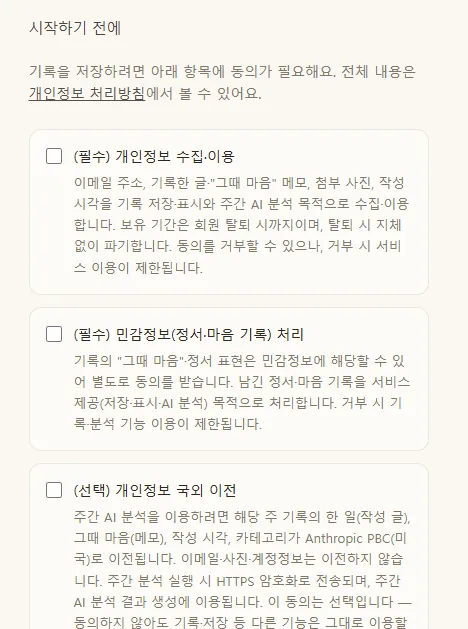
- (Required) General collection/use — service access restricted if refused
- (Required) Sensitive information processing — journaling/analysis features restricted if refused
- (Optional) Cross-border transfer — saving/display features remain unaffected even if refused; only weekly AI analysis is disabled
Retrospective
Three things I learned today:
- Optimistic updates must always pair with failure rollback — the moment you decide “I’ll use optimistic updates,” the contract “I’ll explicitly handle failure cases” comes bundled with it. A state with catch blocks entirely missing, like what I found today, doesn’t deserve to call itself optimistic.
- Legal matters aren’t “can’t do it because I don’t know” — they’re “worrying and procrastinating because I don’t know” — there are clear public channels (KISA, PIPC) for free review. Closed beta requirements also turn out to be clearly divided once you search for them.
- AI services inherently carry cross-border transfer issues — this is mandatory until a Korea region opens up. The consent flow needs to be built into the design from the start.
Remaining tasks
- Consent withdrawal UX — users should be able to withdraw consent for any item at any time, but the settings screen isn’t implemented yet. I’ll continue this in the next session.
Further study
1. Deeper dive into optimistic mutation patterns
- TanStack Query’s
onMutate/onError/onSettledrollback flow - Handling race conditions when multiple mutations occur simultaneously under optimistic updates
- What UX to use when notifying users of failure (toast? inline error?)
2. Criteria for determining sensitive information
- The precise definition of sensitive information under the Personal Information Protection Act (ideology/beliefs, health, sex life, genetic information, criminal record, political views, etc.)
- Actual cases of whether “emotional records” qualify as sensitive information — referencing mental health app categories
- Reference: PIPC’s standard privacy policy guidelines
3. Anthropic’s Zero Data Retention (ZDR) option
- Whether an Anthropic ZDR agreement could mitigate cross-border transfer risk through no-storage processing
- Whether this option is available to individual developers as well (Enterprise only?)
4. Standard UX patterns for consent withdrawal
- Immediate halt of data processing and disposal flow when an item is withdrawn
- The practice of clearly stating to users “how quickly withdrawal takes effect”
- Consent management requirements in iOS/Android app store review guidelines
5. Application path for KISA/PIPC free consulting
- The actual application process and turnaround time
- Whether the consulting outcome carries legal defensibility (reference material vs. official review)
- Reference: KISA’s privacy consulting guide