
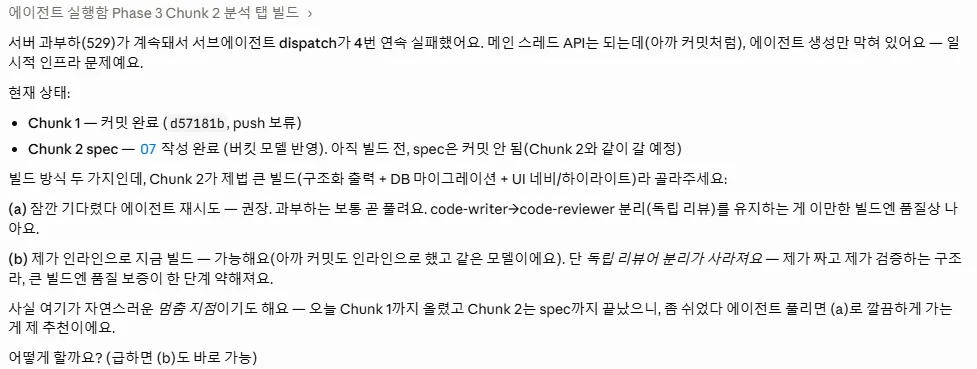
I was coding with Claude Code when it kept telling me agent calls were failing due to server overload. Here’s a short log of tracking down what was going on.
Table of contents
Open Table of contents
1. Checking the error message
API Error: 529 Overloaded. This is a server-side issue,
usually temporary — try again in a moment.
If it persists, check https://status.claude.com.

agentId: a774ac...8bf62
subagent_tokens: 0
tool_uses: 0
duration_ms: 191200
Reading it at a glance, it looked like a temporary server-side issue — nothing I could really do about it — but I looked into it anyway.
529 is in the 5xx range I covered in my post on API design. It’s not a client-side mistake — it’s the server’s fault. If it’s temporary, retrying usually fixes it.
2. Checking the cause of 529 in the Claude API Docs
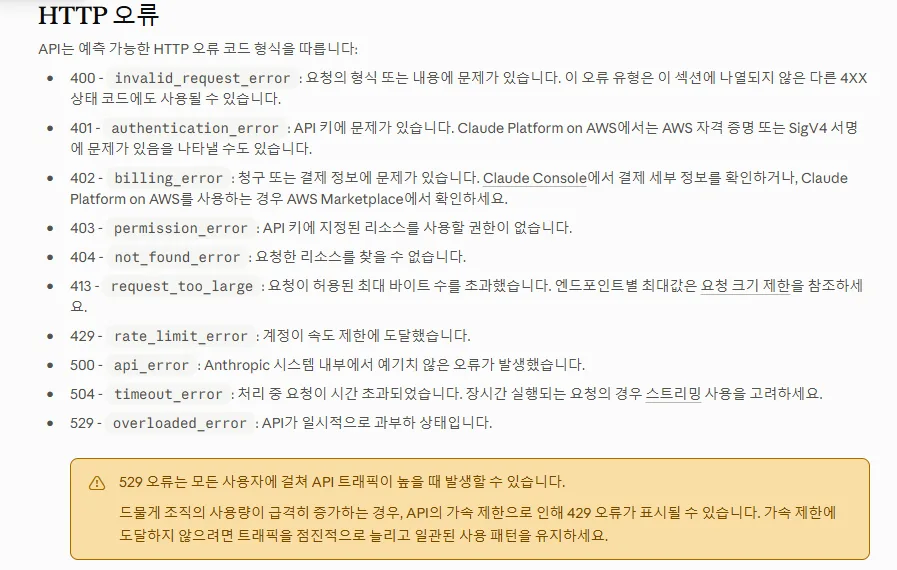
In summary:
- When an organization’s usage suddenly spikes
- When overall usage across all users spikes
This means the server side gets temporarily overloaded. Since I was working the same way I always do in the morning, it seemed unlikely I was the one calling the agent too much — more likely this was an internal issue on Anthropic’s servers themselves.
3. A clue from the developer group chat — status.claude.com
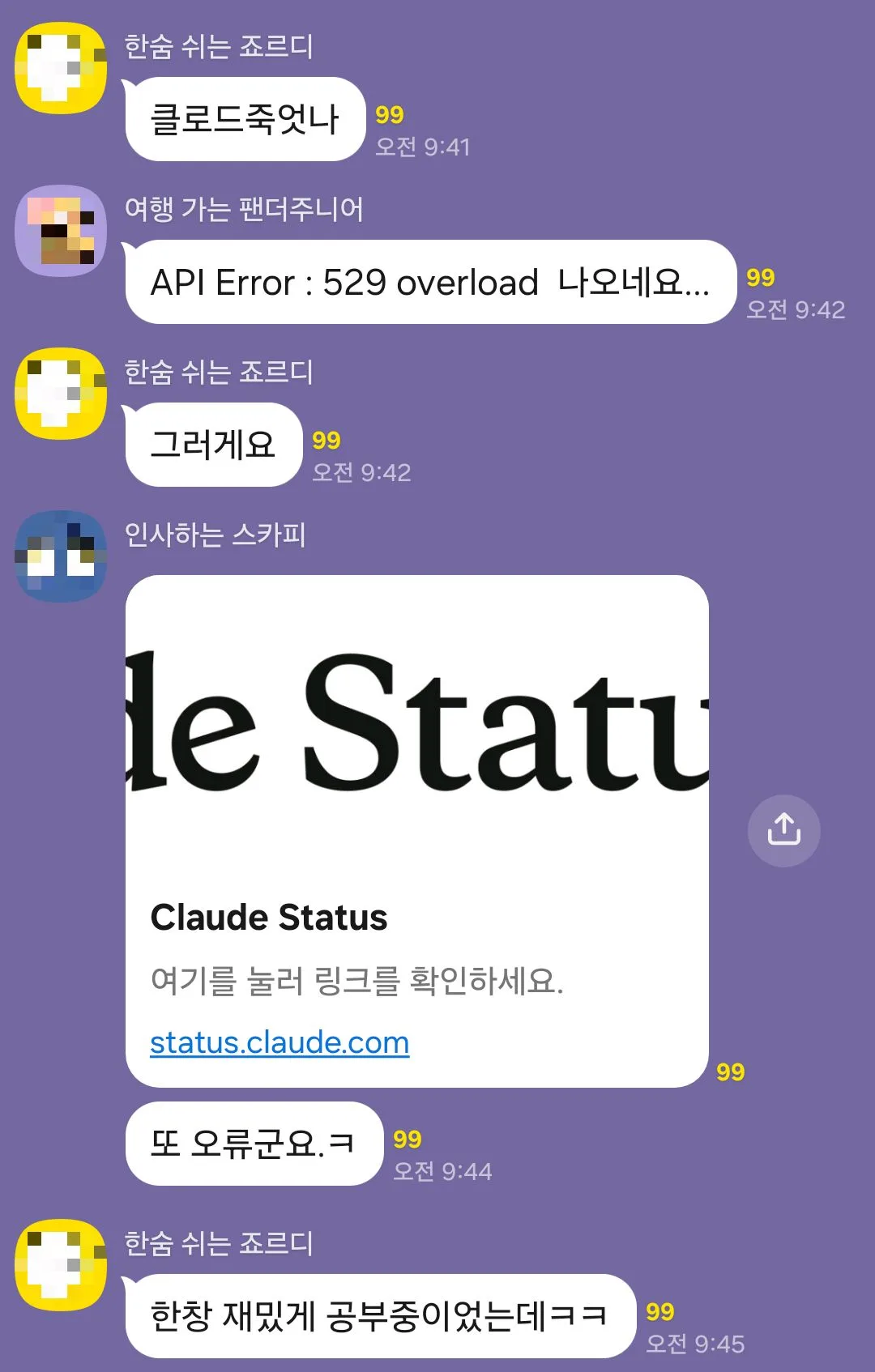
In a developer group chat I’m in, people were dealing with the same error at the same time — chaos. It wasn’t just me — many people had the same symptom. I thought I’d just have to sit and wait for it to clear up, but someone in the chat gave me the tip to check status.claude.com.
(Names in the group chat screenshot have been blurred out.)
4. status.claude.com — Anthropic’s official status page
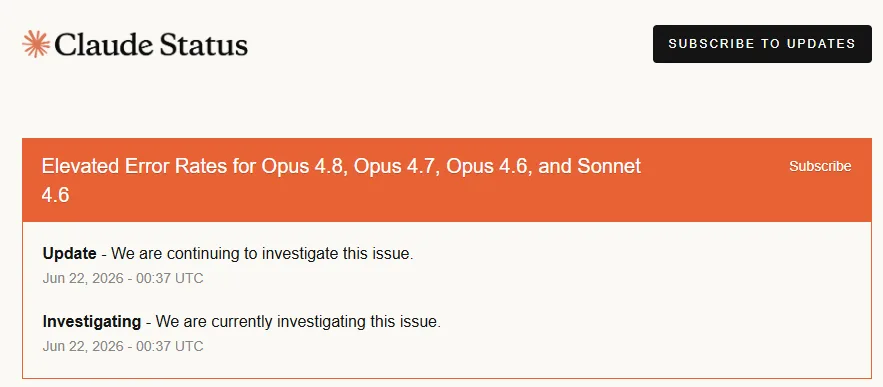
UTC 00:37 = 9:37 AM Korea time. It showed that an error was currently occurring and was still being investigated (Investigating). Once “Resolved” appears here, it means the issue is fixed.
The existence of a status page like this was itself a discovery. If I ever run a service of my own, having something similar would probably help build user trust.
5. Resolution — Opus 4.8 recovered
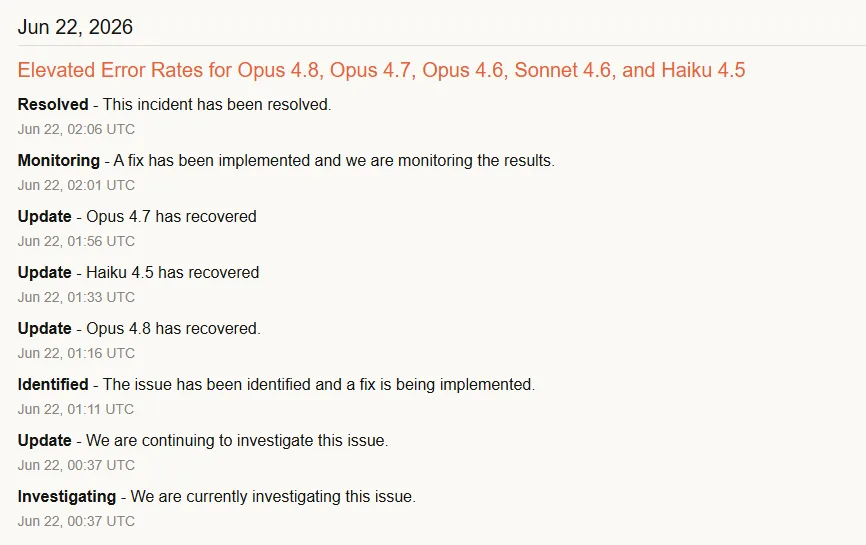
Once Opus 4.8 recovered, I jumped right back into work, so I didn’t see the “Resolved” status appear in real time, but I was able to confirm it later in Past Incidents.
Retrospective
I didn’t actually fix anything myself — I just waited for it to clear up. But I now have a clear sequence of steps for next time something like this happens:
- Check the status code in the error message — 4xx means it’s my fault, 5xx means it’s the server’s fault
- Check what that code means in the official docs (API Docs)
- Check the status page (this time I learned about
status.claude.com) - Quickly figure out whether it’s just me or affecting many people — group chat / Twitter / Reddit
- If it’s widespread, wait. If it’s just me, check reproduction / code / environment.
One thing I want to try next time — multi-LLM provider fallback. Automatically switching to OpenAI when Claude is down would minimize work interruptions. However, Claude Code itself is Anthropic-only, so fallback is hard there — but it’s possible in my own API code.
Things to study further
1. Where 529 stands in the standard
- The official HTTP status code standard (IANA) doesn’t include 529. It’s a non-standard extension
- Some services like Shopify, Cloudflare, and Anthropic use it to mean “site is overloaded”
- The closest standard 5xx alternative: 503 Service Unavailable
- Reference: MDN list of HTTP status codes
2. Automatic retry for 529 in the Anthropic SDK
- The automatic retry policy I covered in my post on error handling
- Whether the SDK treats 529 as retryable (usually 5xx is retried, up to a certain number of attempts)
- Choosing between increasing
max_retriesto retry more persistently vs. giving up early and falling back
3. The general structure of a status page
- Incident (occurs) → Investigating → Identified (cause found) → Monitoring → Resolved
- Status pages Korean users commonly check: GitHub Status, Slack, OpenAI, Anthropic
- Tools for running your own status page: Atlassian Statuspage, Better Uptime, Instatus
4. Multi-LLM provider fallback patterns
- LangChain’s
with_fallbacks()— automatically falls back to a second model if the first fails - Libraries like LiteLLM — a unified interface across multiple providers
- Cost optimization angle — use a cheap model normally, switch to an expensive one on failure
- Maintaining consistent response quality is a challenge
5. Meta information about Claude Code’s agents / sub-agents
- The exact meaning of
agentId,subagent_tokens,tool_uses, andduration_msshown in the error message - How Claude Code’s agent calls sub-agents (multi-agent orchestration)
- How to make use of this information when debugging
- Official Claude Code docs